Hivemind 2026.03.02: Thinking Models, Plugins, Self-Evolving Agents, and 85 Other Things
· Hivemind Team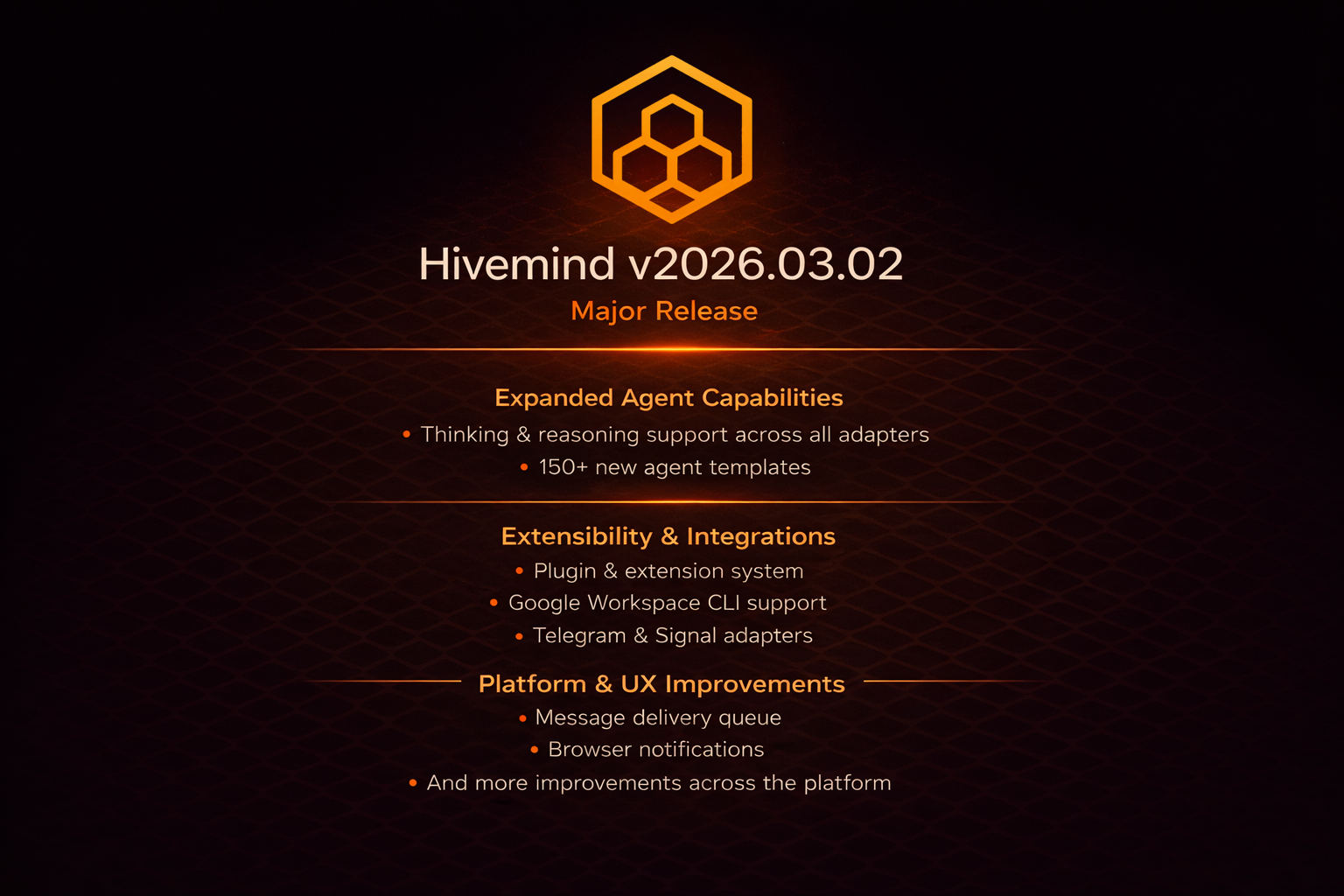
85+ Changes. Here's What Shipped.
85+ changes since 2026.03.01. This release pushes Hivemind from "capable" to "complete" — and then keeps going.
Thinking and Reasoning — Across Every Adapter
Extended thinking is now a first-class citizen in Hivemind. Every adapter — Anthropic, OpenAI, Ollama, Gemini, and all OpenAI-compatible providers — supports thinking and reasoning tokens natively.
You configure it per-agent via the new Per-Agent Advanced Model Settings panel. No global flags, no restarting services. Set a thinking budget on your research agent, leave your chat agent lean.
MCP Client Support
Agents can now connect to any MCP server as a client. Drop an MCP server URL into an agent's tool configuration and it gains access to that server's full tool catalog at runtime.
This pairs naturally with the new plugin system (more below) and means agents in your Hivemind instance can reach out to external MCP registries, internal tooling APIs, or anything else that speaks the MCP protocol.
The Plugin System
Hivemind now has a plugin architecture.
Drop plugin files into the \plugins/\ directory. Plugins can register:
- Custom tools — new capabilities available to any agent
- Channel adapters — connect Hivemind to messaging platforms beyond the five built-ins
- Hooks — intercept and transform messages, tool calls, or responses
The plugin directory is mounted into the container, so you don't rebuild to add capabilities. Write a plugin, drop it in, restart the worker.
Agent Self-Evolution
Agents can now create their own tools and skills at runtime.
When an agent determines it needs a capability it doesn't have, it can write a tool definition and register it — persisted to its tool library for future use. This is not a gimmick. It's the logical endpoint of the Hivemind philosophy: specialized agents that get more specialized over time.
Self-evolution is controlled per-agent and logs every creation event for review.
Live Canvas + Speech-to-Text
Live Canvas is now available to agents with the appropriate tools enabled. Agents can render structured visual output — diagrams, layouts, live documents — directly into the chat interface.
Speech-to-text input is also live. Talk to your agents.
Google Workspace OAuth
Agents can now authenticate with Google Workspace and operate Drive, Calendar, and Gmail on your behalf.
OAuth tokens are stored in Hivemind's AES-256-GCM vault. Agents never see the raw credentials — they call authorized tools that handle the OAuth flow transparently. Setup is in the Integrations panel.
Two New Channels: Telegram and Signal
Hivemind now supports five messaging platforms:
| Platform | Status |
| Discord | ✓ |
| Slack | ✓ (multi-bot) |
| ✓ | |
| Telegram | ✓ New |
| Signal | ✓ New |
Configure Telegram and Signal the same way as the others — channel credentials in the Channels panel, assign to a team, done.
Team Token Analytics
Every team now has a Token Analytics dashboard with agent-level drilldown.
You can see:
- Token consumption per agent, per time period
- Cost breakdown by provider
- Budget enforcement thresholds with configurable alerts
If you're running multiple teams or billing back to clients or departments, this is the feature you've been waiting for.
150+ Agent Templates
The template library now ships with 150+ ready-to-deploy agent configurations across 18 categories:
- Research & analysis
- Software engineering
- Writing & content
- Data & finance
- DevOps & infrastructure
- Customer support
- And 12 more
Every template has a real personality, real memory awareness, and real tool assignments. Not stubs — actual deployable agents.
Browse and deploy from Agents → Templates in the UI.
OpenAI-Compatible Providers
vLLM, LocalAI, LM Studio, and any other OpenAI API-compatible inference server now works as a Hivemind provider.
Add the base URL and API key (or leave the key blank for local servers) in the Provider panel. Hivemind routes requests through its standard adapter layer — thinking support, tool calls, conversation history, all included.
Gemini Multimodal Embeddings
Hivemind's embedding system now supports Gemini multimodal models. Text, images, documents — embedded and retrievable through the same semantic memory interface.
Combined with the hybrid memory context loading also in this release, agents now pull relevant memory from both vector similarity and recency signals.
Full Teams CRUD
You can now create, list, edit, and delete teams entirely from the UI. No more config file editing for team management.
Memory System Overhaul
The memory system got a full rework:
- Structured facts only — the \
#remember\/ \#forget\system now stores discrete facts, not raw transcript chunks. Memories are cleaner, more retrievable, more useful. - File-based memory for SDK agents — SDK path agents (like Claude Code) now use a file-synced memory layer with 30-minute staleness detection, keeping them in sync without database round-trips.
- Hybrid context loading — memory retrieval combines vector similarity with recency scoring.
- LLM summarizer — the memory system uses the cheapest available provider to summarize and compress memory automatically.
Scheduled Tasks, Now Actually Working
The Scheduled Tasks page is fully functional — create, edit, pause, run, delete, and reassign cron tasks from the UI. The previous implementation was a stub that synced nothing to Sidekiq. That's fixed.
A backfill rake task runs automatically on deploy to sync any existing task records into Sidekiq Cron.
The Sidekiq Web UI is now accessible at \/sidekiq\ with HTTP Basic Auth using your admin email and password.
Significant Fixes
A few fixes worth calling out specifically:
Agents losing context — \RAW_MESSAGES_TO_KEEP\ was bumped from 4 to 20, and the SDK proxy now includes the full conversation transcript. Agents were effectively amnesiac beyond the last few exchanges. This is fixed.
SDK proxy race condition — a race condition in the SDK proxy could cause responses to get squashed or dropped. Fixed, along with cleanup of exit listeners that were accumulating on long-running sessions.
API read timeout — extended to 10 minutes. Long-running tasks (deep research, code generation, complex analysis) were hitting the previous timeout wall. They no longer do.
Delegation blank responses — agents delegating to sub-agents were occasionally returning blank responses due to context leaking between delegation chains. Fixed.
Upgrade
\\\`
hivemind upgrade
\\\`
The scheduled tasks backfill runs automatically on deploy. No manual steps required.
Full changelog: 2026.03.01 → 2026.03.02
Questions or feedback? Find us on Discord or open an issue on GitHub.