Why Your AI Agent Needs a Team, Not a Bigger Context Window
· Hivemind Team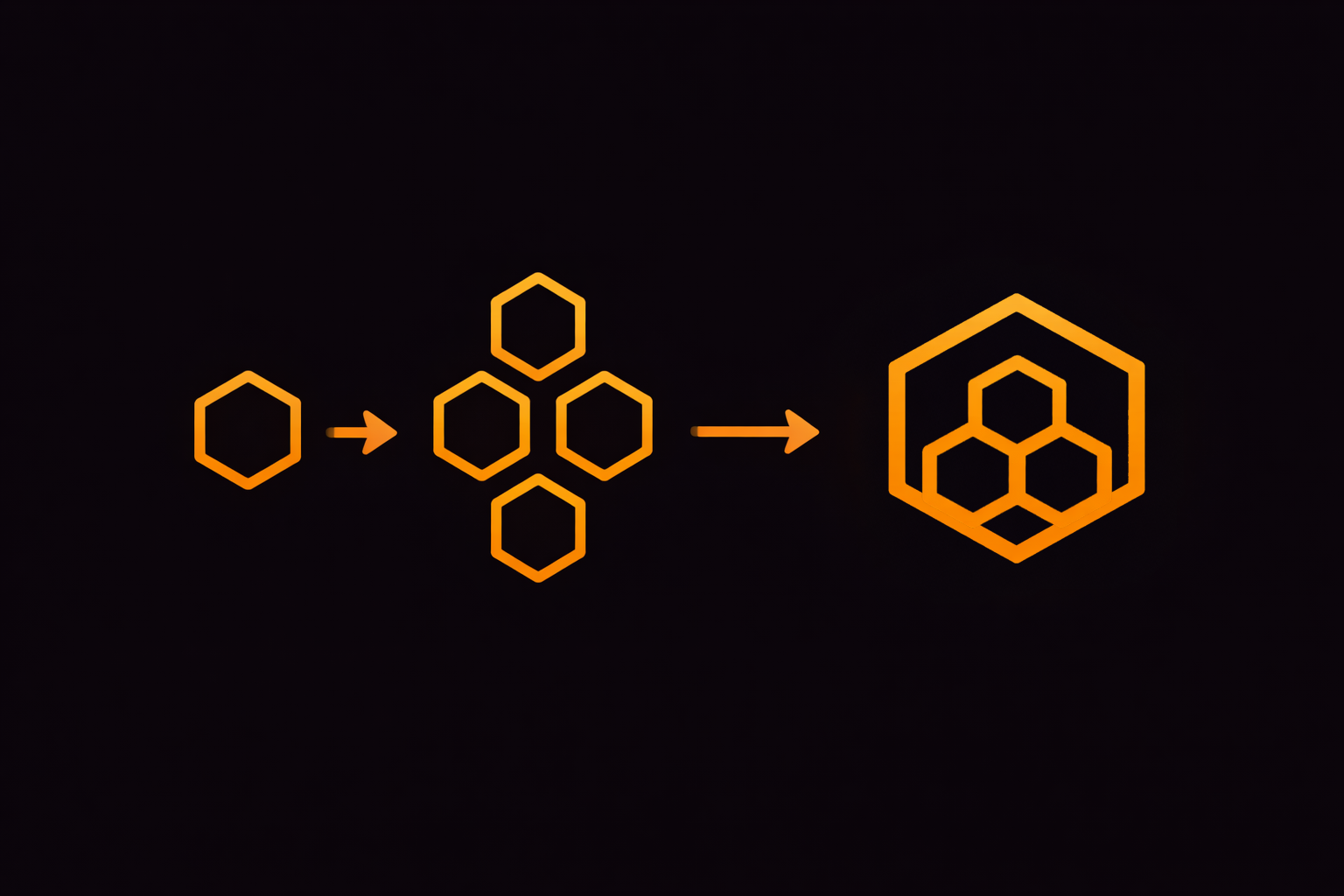
The Monolith Problem
Every AI agent project starts the same way. You spin up a single agent, give it a system prompt, connect a few tools, and watch it work. For simple tasks — summarize this document, draft this email, answer this question — it's magic. Then you try to make it do real work.
You need it to monitor your infrastructure, so you give it access to your cloud provider's API. You need it to respond to incidents, so you add PagerDuty and your logging stack. You need it to fix things, so you hand it deployment credentials, database access, and SSH keys. You need it to communicate results, so you connect Slack, email, and your ticketing system.
Congratulations. You've built a monolith.
Your single agent now has one context window trying to hold infrastructure topology, incident response playbooks, deployment procedures, and communication protocols simultaneously. One model making decisions about whether to restart a service or escalate to a human. One set of permissions that includes everything from read-only log access to production database credentials.
This is the same anti-pattern that software engineering solved two decades ago. We stopped building monolithic applications not because they couldn't work, but because they couldn't scale, couldn't be secured, and couldn't be reasoned about. A single application with access to every database, every API, and every secret is a liability. We learned to decompose.
AI agents are at the same inflection point. The single-agent model works fine for demos. It falls apart in production. Not because the models aren't capable enough — they are — but because cramming every capability into one agent creates the same problems that monolithic software creates: bloated context, confused reasoning, overprivileged access, and catastrophic failure modes.
When your monolith agent hallucinates, it hallucinates with production credentials.
The Team Model
The alternative is the same insight that transformed software architecture: specialized agents composed into teams outperform generalist agents at every scale.
In Hivemind, you don't build one agent that does everything. You build a team where each agent has a specific role, a specific set of tools, and a specific scope of authority. The DevOps Team template is a concrete example:
\\\`
Team: DevOps
| -- Triager Agent |
| Role: Monitor alerts, classify severity, route to specialists |
| Tools: PagerDuty, CloudWatch, log search |
| Permissions: Read-only |
| -- Diagnostics Agent |
| Role: Investigate incidents, correlate signals, identify root cause |
| Tools: Log aggregation, metrics dashboards, trace analysis |
| Permissions: Read-only + scoped API access |
| -- Remediation Agent |
| Role: Execute fixes, roll back deployments, scale resources |
| Tools: Deployment pipeline, infrastructure API, runbook executor |
| Permissions: Write access to specific services |
| -- Comms Agent |
| Role: Post status updates, notify stakeholders, update tickets |
| Tools: Slack, PagerDuty, Jira |
| Permissions: Write access to communication channels only |
\\\`
Each agent is smaller, more focused, and more predictable than a monolith. The Triager doesn't need deployment credentials. The Remediation agent doesn't need to read every Slack channel. The Comms agent can't restart services. Each context window holds only the information relevant to that agent's job, which means better reasoning with less noise.
This isn't just a cleaner architecture — it's a fundamentally more capable one. A specialized Diagnostics agent with a focused context window and curated tools will outperform a generalist agent that's trying to simultaneously hold alert routing logic, log query syntax, deployment procedures, and Slack formatting templates. Less context pollution means better tool selection, fewer hallucinations, and more reliable outputs.
The composition model also means you can mix models per agent. Your Triager — which needs fast classification — might run on a smaller, cheaper model. Your Diagnostics agent — which needs deep reasoning over complex log data — might run on a larger model. Your Comms agent — which writes status updates — doesn't need a frontier model at all. In a monolith, you're paying frontier-model prices for every token, including the ones spent formatting Slack messages.
Hivemind ships 16 agent templates that encode these patterns. The DevOps Team, the Research Squad, the Content Pipeline, the Security Response Unit. Each one is a proven composition of specialized agents that you can import with a single command and customize for your environment:
\\\`bash
hivemind teams:import devops
\\\`
Security Through Separation
The security argument for multi-agent teams is even stronger than the performance argument. It comes down to a principle that's been foundational in security engineering for decades: least privilege.
In a single-agent architecture, the agent needs every permission it might ever use. If it might need to deploy code on Tuesday and query logs on Wednesday, it holds both permissions all the time. There's no mechanism to scope access by task because there's no concept of a task boundary — it's all one continuous context.
Multi-agent teams create natural permission boundaries. Each agent holds only the credentials it needs for its specific role. The blast radius of any single compromise is limited to that agent's scope.
Consider the attack surface difference:
\\\`
Single Agent (Monolith):
Compromised agent = access to ALL tools, ALL credentials, ALL data
Blast radius: Total
Multi-Agent Team (Hivemind):
Compromised Comms Agent = access to Slack + Jira
Blast radius: Communication channels only
Production credentials: Untouched
Database access: Untouched
Infrastructure API: Untouched
\\\`
In Hivemind, this isn't just a design principle — it's enforced at the architecture level. Each agent's credentials are stored in isolated vault scopes. Each agent's tool invocations run in separate sandboxed containers. An agent literally cannot access another agent's secrets, even if its model is tricked by a prompt injection attack. The runtime won't serve the credentials because the requesting identity doesn't have scope.
This is the same isolation model that cloud providers use for IAM roles, that operating systems use for process permissions, and that container orchestrators use for pod security policies. It's a proven pattern. We're just applying it to AI agents.
The audit story also improves dramatically. When a single agent takes an action, the audit log shows "agent did X." When a team of agents takes an action, the audit trail shows exactly which agent initiated the request, which agent approved it, which agent executed it, and what credentials were used. You get the kind of separation of duties that compliance frameworks actually care about.
The Collaboration Layer
Specialized agents are only useful if they can work together effectively. This is where most multi-agent frameworks fall apart — they treat inter-agent communication as an afterthought, relying on shared memory stores or rigid pipeline architectures that can't handle real-world workflows.
Hivemind's collaboration model is built on four primitives:
@mentions — Any agent can mention another agent in its reasoning. When the Triager agent determines that an alert requires deep investigation, it \@diagnostics\ with the alert context. The Diagnostics agent receives a structured handoff that includes the alert data, the Triager's classification, and any relevant context from the conversation history. No copy-paste, no lost context, no manual wiring.
Delegation — Agents can formally delegate tasks to other agents and await results. The Diagnostics agent might delegate "pull the last 30 minutes of error logs from the payments service" to a specialized Log Retriever agent, receive the results, and continue its analysis. Delegation is tracked — every delegation creates an audit entry showing who requested what, who fulfilled it, and what was returned.
Spawn — For dynamic workloads, agents can spawn temporary sub-agents with scoped permissions. If the Diagnostics agent needs to investigate three services simultaneously, it can spawn three investigation sub-agents, each scoped to a specific service, and aggregate their findings. Spawned agents inherit their parent's permission ceiling but can be further constrained. They're automatically cleaned up when their task completes.
Audit trails — Every inter-agent interaction is logged with full context: the requesting agent, the receiving agent, the payload, the timestamp, and the result. When something goes wrong, you can trace the exact chain of decisions across agent boundaries. This isn't just logging — it's a causal graph of agent collaboration that you can query, visualize, and audit.
These primitives compose naturally. A real incident response might look like this:
\\\`
- Triager receives CloudWatch alarm
- Triager classifies: severity=high, service=payments
- Triager @diagnostics with alarm context
- Diagnostics spawns log-retriever (scoped: payments service)
- Diagnostics spawns metrics-fetcher (scoped: payments service)
- Diagnostics correlates findings, identifies: bad deploy at 14:32
- Diagnostics @remediation with root cause analysis
- Remediation executes rollback via deployment pipeline
- Remediation @comms with resolution summary
- Comms posts status update to #incidents, updates PagerDuty, closes Jira ticket
\\\`
Ten steps, four agents, three permission scopes, zero cases where an agent had access to something it didn't need. Every step is logged. Every handoff is traceable. Every credential access is scoped and auditable.
Try It
The DevOps Agent template ships with Hivemind out of the box and each agent can have a defined set of tools.
Each agent starts with sensible defaults that you can override. The Triager's classification logic, the Diagnostics agent's investigation playbook, the Remediation agent's approved actions, the Comms agent's message templates — everything is configurable through Hivemind's agent settings.
If you're running a monolith agent today, you don't have to migrate all at once. Start by extracting one role — maybe the alert triage or the status updates — into a dedicated agent. See how it performs compared to the monolith. Then extract another. This is the same strangler fig pattern that works for decomposing monolithic applications, and it works just as well for decomposing monolithic agents.
Your agents don't need a bigger context window. They need smaller, focused roles with clear boundaries and vector based memories. They need a team.
Stop scaling the monolith. Start building the team.